

Staying in the Game

Staying in the Game: Perspective, Restraint, and What Actually Moves the Needle
Progress at this level is rarely about doing more.
It’s about seeing more clearly.
The higher you climb, the fewer moves actually matter. What creates momentum isn’t activity. It’s timing, positioning, and the ability to stay in the game long enough for the right opportunities to surface.
This article explores several principles that consistently show up among high performers: perspective, restraint, fundamentals, and clarity of direction.
The Problem With Being Inside the Bottle
It’s difficult to see what’s holding you back when you’re standing in the middle of it.
Blind spots aren’t caused by lack of intelligence or effort. They’re caused by proximity. When you’re deep in the work, managing decisions, pressure, and responsibility, your view naturally narrows.
Progress often comes not from new information, but from a shift in perspective. Seeing the same situation from a slightly different angle can unlock options that were always there but impossible to notice from the inside.
This is why relationships and thoughtful reflection matter. Not because they add more inputs, but because they help you see what you’ve been missing.
Fundamentals Are Necessary, but Not Sufficient
Doing the fundamentals well is table stakes.
They keep you solvent. They keep you operational. They keep you alive.
But fundamentals alone don’t guarantee meaningful wins.
Winning, whether in business, investing, or life, also requires timing, randomness, and opportunity. What many people label as “luck” is often the byproduct of staying in the game long enough for the odds to tilt in your favor.
You can’t benefit from opportunity if you’ve already exited the field.
The goal isn’t to predict outcomes. It’s to position yourself so that when something breaks your way, you’re still standing.
The Two Modes of Decision-Making
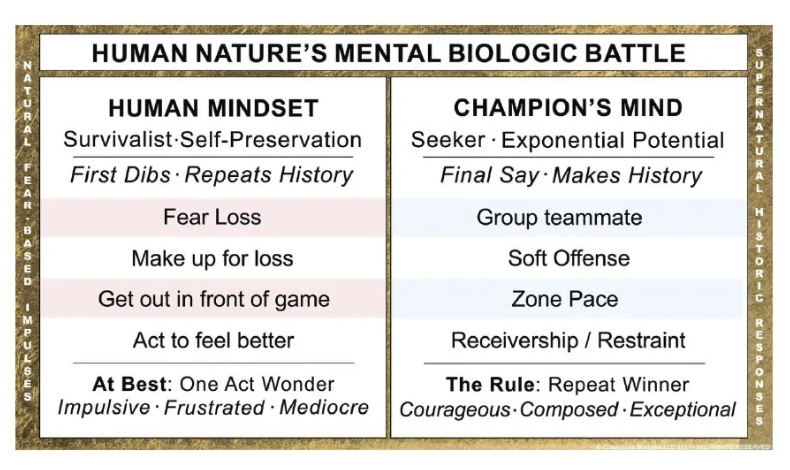
Every decision is filtered through one of two lenses.
The first is the human mindset.
This mode is biological. It’s wired for survival. It reacts to fear, loss, and uncertainty. It pushes toward action, not because action is correct, but because action feels relieving.
The second is the champion’s mind.
This mode is deliberate. It prioritizes restraint, patience, and long-term outcomes. It doesn’t eliminate fear, t simply doesn’t allow fear to make the final call.
The breakthrough isn’t removing the human mindset. That’s impossible.
The breakthrough is learning to recognize it.
When you can label fear-based impulses in real time, you regain choice. And with choice comes better decisions.
Restraint, Receivership, and Creating Space
Many poor decisions are made not because of bad intent, but because of cognitive overload.
When everything feels urgent, clarity disappears.
Receivership is the act of creating space, mentally and operationally, so that better decisions can surface. This isn’t passive. It’s intentional.
It may look like stepping back. Slowing down. Paying back energy debt.
Counterintuitively, some of the most productive moves come from temporarily doing less. Space allows patterns to emerge. It allows insight to arrive rather than be forced.
Execution delivers results. Receivership creates direction.
You need both.
Focus Comes From Constraints
Clarity isn’t created by listing everything that could be done.
It’s created by deciding what matters most.
Most businesses, and most individuals, are constrained by one primary bottleneck at any given time. Identifying that constraint simplifies everything.
Rather than chasing multiple improvements at once, progress accelerates when you pull the single lever that creates the greatest impact.
This typically falls into one of four categories:
- More customers
- More valuable customers
- Reduced risk
- Increased throughput
Once the lever is clear, direction follows.
Direction Before Speed
Speed without direction creates waste.
Before accelerating, it’s worth answering one question:
What are the few things that must go right next?
Whether you’re leading a team or operating solo, clarity here compounds. It aligns effort, reduces noise, and prevents unnecessary motion.
Progress doesn’t require perfect certainty.
It requires enough clarity to stay in the game, and enough restraint to wait for the right moments to move.
That’s how momentum is built.
Not by doing more.
But by doing the right things, at the right time.
